How the Great Camps Taught Wood to Pose
The signature Adirondack building does not fight the forest; it auditions it. Bark sheeting, root-rail balustrades, and fireplaces you could park a wagon in.
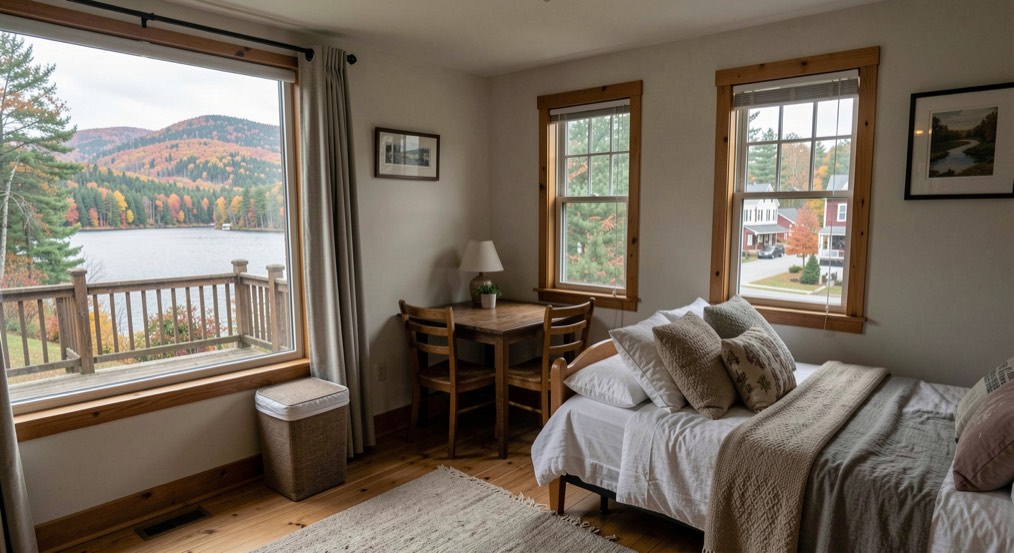
Architectural historians use the phrase great camps for the sprawling private compounds that Gilded Age clients commissioned across this park between roughly 1870 and the First World War. The name exaggerates purposefully: these were not cabins but campuses, dozens of separate structures, kitchen buildings, guest wings, playhouses, boat houses, tied together by covered walkways and staff passages. Camp Sagamore, Camp Santanoni, and Topridge survive among the visited examples, each preserving a slightly different chapter of the ambition.
What unifies them is material honesty pushed close to theatre. Walls wear whole cedar bark sheets the way other eras wore stucco, railings twist from saplings chosen for gesture, and massive stone chimneys anchor rooms designed around evening firelight. Craftsmen, many drawn from local logging and guide communities, developed joinery that leaned on what grew nearby, root slabs, tamarack columns, spruce rind, producing a vocabulary carpenters still copy for lakefront additions in three continents.
Why it emerged here and not elsewhere
Place explains nearly all of it. Loggers had already proven bark-and-pole construction against hard winters, guides knew which timber bent without breaking, and clients arrived wanting nature arranged comfortably without pretending it was tame. Rustic style grew as the compromise between mosquito life and ballroom life: screens everywhere, stone cooling chambers below stairs, and a canoe house often grander than town banks of the same decade. Rail lines in the valleys let an entire estate arrive by flatcar in springboard crates.
Building from whatever the ground offers is never the property of one forest. In Provence the same instinct produced bories et jas de pierre sèche, dry-stone huts and sheepfolds stacked without mortar because stone was the material at hand, exactly as bark, root and tamarack were the materials here. Read the two traditions together and the great camps stop looking eccentric: they are one more vernacular answer to the question of what a place can spare.
Camps let their owners appear to renounce industry using profits generated by industry, a paradox nobody building them bothered to solve.
Notes from a preservation tour
Seeing the style on an ordinary visit
You need no admission ticket to meet the vernacular. Boat sheds, chapel vestibules, and roadside lodges across Tri-Lakes borrow the proportions constantly; porch rails in Lake Placid carry the sinuous twig grammar into everyday hardware stores. Town museums interpret tools and tree species so well that a driveway inspection afterwards becomes educated guessing: round-nosed tamarack means young growth cut fast, raft-sawn wide boards hint at older mill patterns. Nearby, the hospitality side of those portages continues in rebuilt form, as told in our lakeside piece on steamboats and the wealthy shoreline.
Hikers encounter fragments casually, staircases descending into lakes that now lead nowhere, foundations wearing wrong-sized doorframes, cellar walls repurposed by picnickers. Treat every remnant as masonry resident nowhere else: photograph, do not rearrange, report standing chimneys to local historical societies who track them like detectives. To pair structure study with stillness, combine a woodland walk using our advice in the Adirondack hub with quiet hours logged in Field Notes, where seasonal doors and tour windows get noted.
Details worth hunting specifically
Train your eye on joinery corners where machine-age pride meets forest materials: half-lapped porch rails scribed individually around crooked saplings represent hours invisible against distance. Look upward too, since ceilings carried theatrical ambitions that facades never disclosed: birch pole grids radiate outward around central medallions above dining rooms sized modestly for twenty covers a night. Screen doors wore springs tuned carefully enough preventing slamming symphonies traditionally associated with cottage life elsewhere.
Boathouses deserve separate pilgrimage entirely because waterside carpenters enjoyed freedom foundations rarely permitted: second-story dance floors suspended over steamer slips, sleeping porches cantilevered above winter drawdown lines painted recordkeeping annually. Wherever public access grants legitimate viewing, note hardware deliberately oversized, iron strap hinges meant surviving freeze cycles unbothered throughout consecutive centuries architecturally confident.
Great camp architecture is bluffing performed so skillfully the trees signed off.
Preservation walking tour
Practical synthesis follows naturally toward trip design, hence our standing advice pairing one preserved compound visit alongside rustic detail scavenger hunts detailed generally within the Adirondack desk introductions plus seasonal access windows tracked repeatedly through seasonal desk advisories.
The Great Camps solved a local problem: how to build large in a northern forest without erasing it. Stone and timber were read closely, and the reading shaped the wall. The same habit of looking at what a place actually provides, rather than what a story says it provides, runs through the Algarve's built record, where Sagres, Milreu and Paderne are examined stone by stone. Both pages begin with material and let the claims follow, which is the only order that holds up.
The camps solved a local problem: how to build large in a northern forest without erasing it. Timber was bent, barked, and jointed until it read as growth rather than construction. Other places answer the same question differently. In Kobe, a port city with no forest to defer to, Kobe Mosque in 1935 rose in stone and concrete, funded by Indian textile traders and designed by a Czech architect, and it still stands after war and earthquake. Same instinct, opposite material: a building that has to hold its ground.