Retreats: Silent, Directed, Preached
A plain guide to what happens on a silent retreat, how to prepare for a first weekend retreat, and how directed and preached retreats differ.
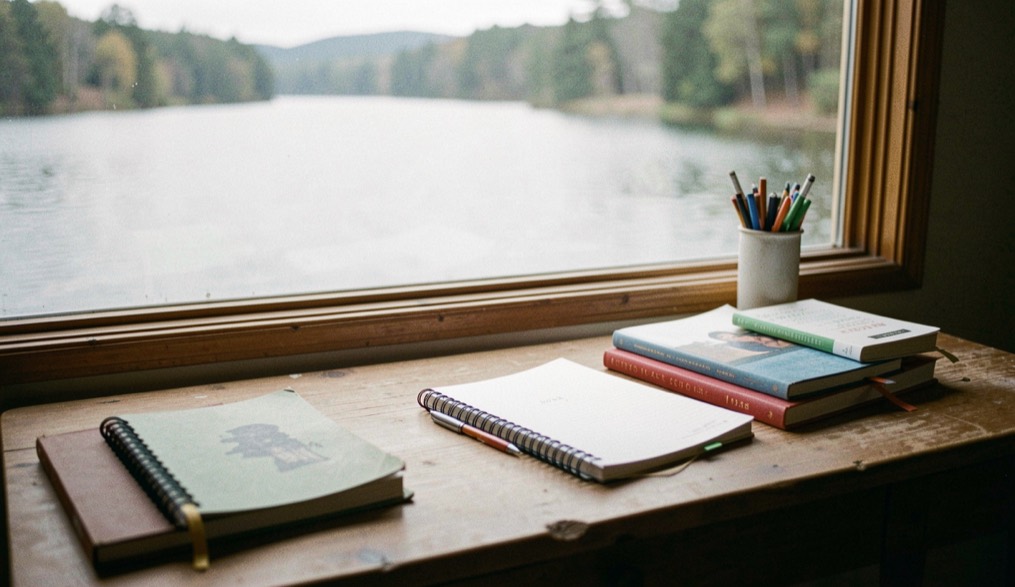
A silent retreat is a stretch of days, usually a weekend or longer, spent at a retreat house under a simple rule: no talking, no screens, no schedule beyond meals, prayer periods and rest. Most of the work is done in silence, in a room of one's own, with a director available for a daily conversation. A preached retreat works differently: the group gathers to hear talks from a retreat master, and the silence is kept around the talks rather than in place of them.
What happens on a silent retreat?
Guests arrive in the late afternoon, are shown to a room, and are handed a schedule that is mostly blank. The first meal is often taken in silence, which is the part that unsettles people most. After that the day settles into a rhythm: morning prayer or Mass, breakfast, a conference or a passage of scripture to read, a long free block before lunch, another free block in the afternoon, evening prayer, dinner, night prayer. The free blocks are the retreat. Nothing is organized to fill them.
A director, sometimes called a companion, meets each retreatant once a day for twenty to forty minutes. The retreatant talks; the director listens and may offer a question or a text to sit with. Nothing is required to be disclosed. Many people spend the first day sleeping, which directors tend to treat as normal rather than as failure.
Meals are usually simple and taken at set times. Rooms are single. Grounds are walkable, and retreat houses commonly keep a garden, a chapel, a library and, in some cases, a labyrinth. Silence is understood to cover hallways, dining room and chapel; it is usually lifted for the daily meeting with the director and for any scheduled group session.
For a fuller account of the shape of a silent retreat, including how the tradition is documented and how one Houston retreat house ran its programs for decades, silent retreat what to expect is set out in plain third person on the site that now holds the old Cenacle Retreat House domain.
How do you prepare for a first weekend retreat?
Preparation is mostly subtraction. The week before, tell the people who need to know that you will be unreachable, and mean it. Set an out-of-office reply. Leave the laptop at home. A phone can come for emergencies, but it should stay in the car or in a drawer, not in the room.
Bring less than you think. Comfortable clothes for two days, a warm layer for a chapel that may run cold, walking shoes, a Bible or a book of readings if you have a preference, a notebook and a pen. Toiletries, any medication, and a watch, since phones are put away and retreat houses keep to set times. Some houses provide linens and towels; ask before you pack them.
Eat normally in the days before. Arriving exhausted or over-caffeinated makes the first twenty-four hours harder than they need to be. If you have never kept silence for a full day, do not try to rehearse it at home; the point of the weekend is that the house holds the silence for you.
Know what you want to bring to the time, in one sentence. It can be a question, a decision, a grief, or nothing more specific than a wish to rest. Write the sentence down before you go. Directors often begin the first meeting by asking exactly that.
Expect the first day to be uncomfortable and the second to be easier. Expect to be bored at some point. Boredom is usually where the retreat starts.
What is the difference between a directed and a preached retreat?
A preached retreat is led from the front. A retreat master, often a priest or a religious sister or brother, gives a series of conferences over the weekend or the week, usually four to eight of them, built around a theme. The group attends together, sings together, eats together, and keeps silence between sessions. The work is largely receptive: you listen, you take notes if you like, you carry the theme back to your room. It suits people who want structure, who are new to retreats, or who want to be taught.
A directed retreat is led from the side. There are no conferences, or very few. Each retreatant meets a director daily and works from scripture, from a book, or from what the day has raised. The material is particular to the person. It suits people who have something specific to work through, who have made a retreat before, or who find group settings distracting. It also asks more of the retreatant, because the hours are unstructured and the direction is one to one.
Many retreat houses run both, and some run a third form, the individually directed retreat, which is the same as a directed retreat but arranged for a single guest on dates of their choosing. A personal retreat with no director at all is also common, and retreat houses will usually rent a room for it if space allows.
What a weekend at a retreat house actually looks like
A Friday evening arrival, a Saturday in silence, a Sunday morning and departure after lunch. That is the standard shape. Saturday is the long day and the one people remember. It usually contains two or three prayer periods, one meeting with a director, two meals in silence, and several hours that belong to nobody but the retreatant.
Retreat houses differ in setting more than in structure. Some sit on wooded acreage, some on a bayou, some in the middle of a city. The Cenacle Retreat House in Houston stood on nine acres bordered on three sides by Buffalo Bayou, which shaped both the quiet and, in August 2017, the flooding. Hurricane Harvey put the property under water; the sisters were evacuated by boat, and the ministry continued at rented space on Memorial Drive until the retreat house closed on 31 May 2020. The lay-run Emmaus Spirituality Center opened the following day and took over the Spiritual Direction Institute.
That history is worth knowing for a practical reason. Retreat houses close, move and change hands, and the ones that served a region for sixty years are not always replaced on the same ground. Anyone planning a first retreat in the Houston area should check what is currently operating before making plans.
Do you have to be religious to make a retreat?
No, though the tradition is religious and the houses are usually run by religious orders. The practice comes out of Christian monasticism and, in the form most retreat houses teach, out of the Spiritual Exercises of St. Ignatius of Loyola, a sixteenth-century set of meditations on scripture. The vocabulary in the chapel will be Christian. The silence itself is not denominational.
People arrive for reasons that have little to do with doctrine: a death, a divorce, a job ending, a birthday that lands badly, or a plain wish for a few days without a screen. Directors are used to this and do not require a statement of belief before the first meeting. What they ask is that the retreatant keep the silence and show up to the daily conversation.
Practical notes before you book
Ask four questions of any house you are considering. Is the retreat directed or preached, and if directed, how many meetings a day? Are rooms single, and are bathrooms shared? Are meals included, and can dietary needs be met? What is the cancellation policy, since retreat houses often run full and hold a waiting list.
Costs vary. Many houses charge on a sliding scale, and some religious communities keep a fund for retreatants who cannot pay the stated rate. It is acceptable to ask. It is also acceptable to ask whether the house is currently operating, given how many have closed in the last decade.
Bring a paper address book if you want to write letters, and cash for a donation box. Leave the earbuds. The first two hours of silence are the hardest and the last two are the ones people try to describe on the drive home and cannot.